

Professional Investigation Equipment plays an important role in modern private investigations, technical surveillance counter-measures, digital forensics and evidence collection. At Nikos Pelekasis & Associates, we combine decades of investigative experience with specialised technical equipment selected according to the requirements of each case.
Technology has transformed private investigation. Modern cases may involve smartphones, computers, wireless communications, GPS technology, digital evidence and sophisticated electronic devices.
However, professional investigation does not depend on a single machine.
Effective technical work requires the appropriate combination of specialised equipment, investigative methodology, technical knowledge and careful interpretation of the findings.
Our technical capabilities support a range of private, corporate and digital investigations.
Depending on the requirements of an assignment, specialised equipment may be used for:
The equipment and methodology used are selected individually according to the environment and objective of each investigation.
Technical Surveillance Counter-Measures (TSCM) involves the systematic examination of an environment for indications of unauthorised electronic surveillance.
A professional TSCM inspection should never depend on only one detector.
Different surveillance devices operate in different ways. Some continuously transmit radio-frequency signals, while others may transmit intermittently, remain inactive for long periods or store information locally.
For this reason, different detection technologies may be required during an inspection.
Radio-frequency analysis is one of the principal technical methods used during electronic surveillance detection.
Professional RF equipment can assist 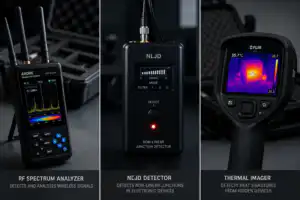 with examining the electromagnetic environment and identifying signals requiring further investigation.
Depending on the environment, these may involve frequencies associated with:
The presence of an RF signal does not automatically mean that a surveillance device is present.
Modern homes, offices and vehicles contain many legitimate wireless devices.
The investigator must therefore distinguish normal electronic activity from signals that justify further examination.
Portable RF detectors can assist in identifying radio-frequency energy in the surrounding environment.
They may be useful during preliminary examination of:
RF detectors are useful investigative tools, but they have limitations.
A device that is switched off, recording locally or not transmitting at the time of inspection may not be identified simply through RF detection.
For this reason, RF detection should normally be combined with additional examination methods.
A Non-Linear Junction Detector (NLJD) is designed to assist in locating electronic components by detecting semiconductor junctions.
Unlike conventional RF detection, NLJD examination does not depend on a surveillance device actively transmitting a signal.
This can make the technology particularly useful when searching for electronic devices that may be:
NLJD examination can therefore complement RF analysis during a comprehensive TSCM inspection.
However, legitimate electronics can also produce responses, meaning that results require professional interpretation and physical verification.
Thermal imaging can provide an additional investigative method during technical inspections.
Electronic components may generate heat during operation.
Depending on the environment and device, a thermal camera may assist in identifying unusual heat signatures associated with concealed electronics.
Thermal examination can be particularly useful when inspecting:
Thermal imaging is not a standalone method for identifying surveillance equipment.
Environmental conditions and ordinary electronics can produce similar thermal signatures, so findings must be evaluated in context.
One of the most important elements of a professional technical inspection remains physical examination.
Surveillance equipment may be concealed in:
Technical equipment can help identify suspicious areas, but careful visual and physical examination remains essential.
Depending on the environment, inspection tools may include specialised lighting, optical inspection devices and other equipment designed to examine difficult-to-access areas.
Hidden cameras can vary significantly in size, design and operating method.
Some transmit video wirelessly, while others record information locally to internal storage.
A technical inspection may therefore combine several methods when searching for concealed cameras.
Depending on the circumstances, examination may involve:
No single detector can reliably identify every possible hidden-camera configuration.
Vehicles present a particularly challenging environment for technical surveillance detection.
Modern vehicles already contain numerous legitimate electronic systems, antennas, wireless modules and communication technologies.
A vehicle inspection may therefore involve a combination of:
The methodology depends significantly on the vehicle’s manufacturer, model, age and electronic architecture.
GPS tracking devices do not all operate in the same way.
Some devices use satellite positioning combined with cellular communication to transmit location information. Others may store location information internally for later retrieval.
Professional examination should therefore not rely exclusively on searching for a continuous radio signal.
Depending on the device, detection may require a combination of:
The objective is to identify unauthorised tracking equipment, while distinguishing it from legitimate factory-installed vehicle electronics.
Modern private investigations increasingly involve electronic evidence.
Our technical capabilities also support Digital Forensics examinations involving devices lawfully provided for investigation.
Depending on the case, this may include:
Digital forensic work can assist in identifying, preserving and analysing electronic information relevant to an investigation.
The specific tools used depend on the device, operating system, security configuration and investigative objective.
Smartphones contain substantial amounts of personal and professional information.
Where lawful authority exists to examine the device, technical investigation may assist in evaluating information relevant to:
Modern Android and iOS devices use sophisticated security and encryption technologies.
For this reason, the possibilities of examination depend significantly on the individual device.
Where there are legitimate indications that a smartphone may have been compromised, specialised examination may be performed to identify relevant technical indicators.
A Mobile Spyware Detection investigation can involve several layers of examination rather than reliance on a single anti-malware application.
Depending on the case, examination may include:
Unusual battery consumption, overheating or unexpected behaviour alone does not prove that spyware is installed.
Technical evidence must be evaluated before conclusions are reached.
Network activity can provide valuable information during certain digital investigations.
Where appropriate and lawfully authorised, network-analysis tools may assist in examining communications between a device and external systems.
This may help identify:
Network analysis requires specialist interpretation because ordinary applications frequently communicate with numerous legitimate internet services.
Tools such as Wireshark can assist investigators in analysing network traffic in appropriate technical examinations.
Packet and traffic analysis may provide information concerning communications occurring over a network.
However, encrypted communications and modern application architectures mean that network traffic does not necessarily reveal the actual content of communications.
Its value depends on the specific investigative objective and technical circumstances.
Computers can contain documents, communications, browser information, photographs and other data relevant to an investigation.
Depending on lawful authority and the objective of the case, technical examination may involve:
Where evidence may have legal importance, preservation of the original data should be considered before unnecessary changes are made to the device.
Deleted information may sometimes remain recoverable from digital storage devices.
Professional Recovery of Deleted Data may involve specialised software and forensic methods depending on the type of storage.
Potential sources include:
Recovery cannot be guaranteed.
Modern encryption, TRIM, secure deletion and continued use of the device can make some information permanently inaccessible.
Technical equipment is only one part of an investigation.
Proper documentation of relevant findings can be equally important.
Depending on the assignment, investigative documentation may involve:
The purpose is to create a clear record of relevant findings and the circumstances in which they were identified.
Lawful physical surveillance may require specialised photographic, video and observational equipment.
The equipment selected depends on:
Professional surveillance is not simply a question of using powerful cameras.
Experience, positioning, discretion and appropriate documentation remain essential.
Certain investigations take place in difficult lighting conditions or environments where investigators must maintain appropriate distance.
Specialised optical and imaging equipment may assist with observation and documentation under these circumstances.
However, technical capability does not remove legal restrictions concerning privacy or areas where an individual has a reasonable expectation of privacy.
Equipment must always be used within the applicable legal framework.
One of the most important principles of modern private investigation is that equipment supports the investigator — it does not replace the investigator.
A detector may identify a signal.
A thermal camera may identify an unusual heat source.
An NLJD may indicate the presence of electronic components.
Network analysis may identify an unusual connection.
None of these findings automatically establishes wrongdoing.
Professional investigation requires each technical finding to be evaluated within the broader context of the case.
For this reason, complex technical investigations often combine several methodologies.
For example, a TSCM inspection may involve:
The exact procedure depends on the environment and the objective of the inspection.
Investigation technology develops continuously.
New wireless technologies, smartphones, communication protocols and surveillance devices regularly enter the market.
For this reason, professional capability requires more than purchasing equipment.
Investigators must remain familiar with:
Our approach combines specialised equipment with ongoing technical education and investigative experience.
Corporate investigations can involve particularly sensitive environments.
Depending on the circumstances, technical equipment may assist in investigations concerning:
TSCM and digital forensic capabilities can therefore complement traditional corporate investigation methods.
Law firms may require technical investigative assistance where a case involves digital evidence, electronic surveillance concerns or specialised evidence collection.
Depending on the assignment, our technical services can assist with:
Where findings may be used in litigation, coordination with the client’s lawyer is recommended.
Technical investigation is not limited to corporations.
Private clients may require specialist examination in situations involving:
Before recommending a technical inspection, we evaluate the circumstances and determine which methods are realistically relevant.
No professional investigator should claim that one machine can detect every surveillance device or solve every digital investigation.
Technical limitations can arise because of:
A professional assessment should therefore explain both what was identified and what cannot be technically established.
Professional investigation equipment must be used within the applicable legal framework.
Technical capability does not automatically create legal authority to:
Our technical investigation services focus on lawful detection, examination, analysis and documentation.
Nikos Pelekasis & Associates combines decades of investigative experience with modern technical capabilities.
Our professional background extends across traditional investigation, technical systems and modern digital investigation.
Depending on the assignment, our investigations can combine:
We do not depend on a single device or detection method.
The methodology is selected according to the specific technical environment and investigative objective.
Equipment produces information.
The investigator must determine what that information means.
Our approach focuses on verification and evidence rather than assumptions based solely on detector alerts.
Technical investigations can involve highly sensitive personal and corporate information.
Every assignment is therefore handled with particular attention to discretion and confidentiality.
Professional investigators may use photographic equipment, RF detection systems, spectrum-analysis equipment, digital forensic tools, network-analysis software and other specialised equipment depending on the investigation.
A TSCM inspection may combine RF spectrum analysis, electronic detection, NLJD technology, thermal imaging, physical inspection and other appropriate methods.
Potentially. Different GPS trackers operate differently, so professional inspection may require RF analysis, physical inspection and other detection methods rather than reliance on one detector.
Certain detection methods, including NLJD examination, may assist in identifying electronic components even when a device is not actively transmitting. Detection is not guaranteed and findings require verification.
Technical inspections can combine RF, optical, thermal and physical examination methods to search for suspicious devices. No single detector can identify every possible hidden-camera configuration.
Yes, where the owner or another appropriately authorised person provides the device for examination. The methodology depends on the device and circumstances.
Yes. Digital forensic services can be provided for appropriate devices where lawful authority for examination exists.
No. Surveillance devices use different technologies and operating methods. Comprehensive technical inspections therefore use multiple detection methods.
Modern investigation increasingly requires a combination of traditional investigative experience and specialised technology.
At Nikos Pelekasis & Associates, professional equipment is used as part of a broader investigative methodology rather than as a substitute for professional judgement.
Our technical capabilities support TSCM bug sweeps, Digital Forensics, mobile spyware detection, vehicle inspections, evidence collection and other specialised investigations in Athens, Piraeus and throughout Greece.
If your case involves suspected electronic surveillance, digital evidence or another technical concern, contact our office for an initial confidential assessment.